
Apply engineering knowledge to design and support electrical systems in practice
This qualification covers the competencies required to design, validate, and evaluate electrical equipment and systems, and to provide technical advice and sales support.
The UEE62122 Advanced Diploma of Engineering Technology – Electrical is a nationally recognised qualification in the Australian VET sector. It provides advanced knowledge and practical skills for designing, testing, and managing complex electrical systems.
Learners develop expertise in key areas including electrical design, power distribution, protection systems, automation, renewable energy integration, and industrial control. The course also emphasises compliance with Australian Standards, workplace safety, and sustainability.
As a graduate, you may become responsible for electrical and control support, and administering and upgrading electrical facilities in small, medium or large-sized enterprises.
You’ll gain skills in the installation, maintenance and administration of electrical and automation infrastructure. These will be applicable to a wide range of business, manufacturing and operational occupations where electrical technology underpins the business operations.
Scheme | Code | Classification value |
|---|---|---|
ANZSCO Identifier | 312312 | Electrical Engineering Technician |
ASCED Qualification/Course Field of Education Identifier | 0313 | Electrical And Electronic Engineering And Technology |
Qualification/Course Level of Education Identifier | 411 | Advanced Diploma |
Taxonomy – Industry Sector | N/A | Electrotechnology |
Taxonomy – Occupation | N/A | Senior Technical Officer (Electrical Engineering),Technical Officer (Electrical Engineering) |
- Applicants must be minimum 18 years of age at the time of commencement;
- Have a valid Student Visa status OR will be granted the Student Visa which would allow them to study in Australia in Vocational AQF levels before the commencement of the course at Albright Institute.
- Must satisfy Albright Pre-training Review (PTR) Assessment.
- Have a valid IELTS score of 5.5 Bands OR PTE score of 42 OR Cambridge score 162 OR TOEFL iBT 46 OR its equivalent (Completed a minimum 10-weeks General English Course of Upper-Intermediate Level)- Within the last 3 Calendar Years OR Completed Australian Qualification minimum from AQF Level 3 (Certificate 3) to Advanced Diploma AQF Level 6 OR Successful completion of Australian Equivalent Year 12 qualification – Within the last 3 Calendar Years;
- Successful completion of Australian Equivalent Year 12 qualification;
- Applicants must undertake the Albright LLN test;
- Applicants should have basic computer and MS Office skills (Word, Excel and Power Point);
Successful completion of twenty-four (24) core units and sixteen (16) elective units as outlined above, a total of forty (40) units of competency of 2,160 weighting points (1,200 core weighting points and 960 general elective weighting points) is required for the award of the UEE62122 Advanced Diploma of Engineering Technology – Electrical course.
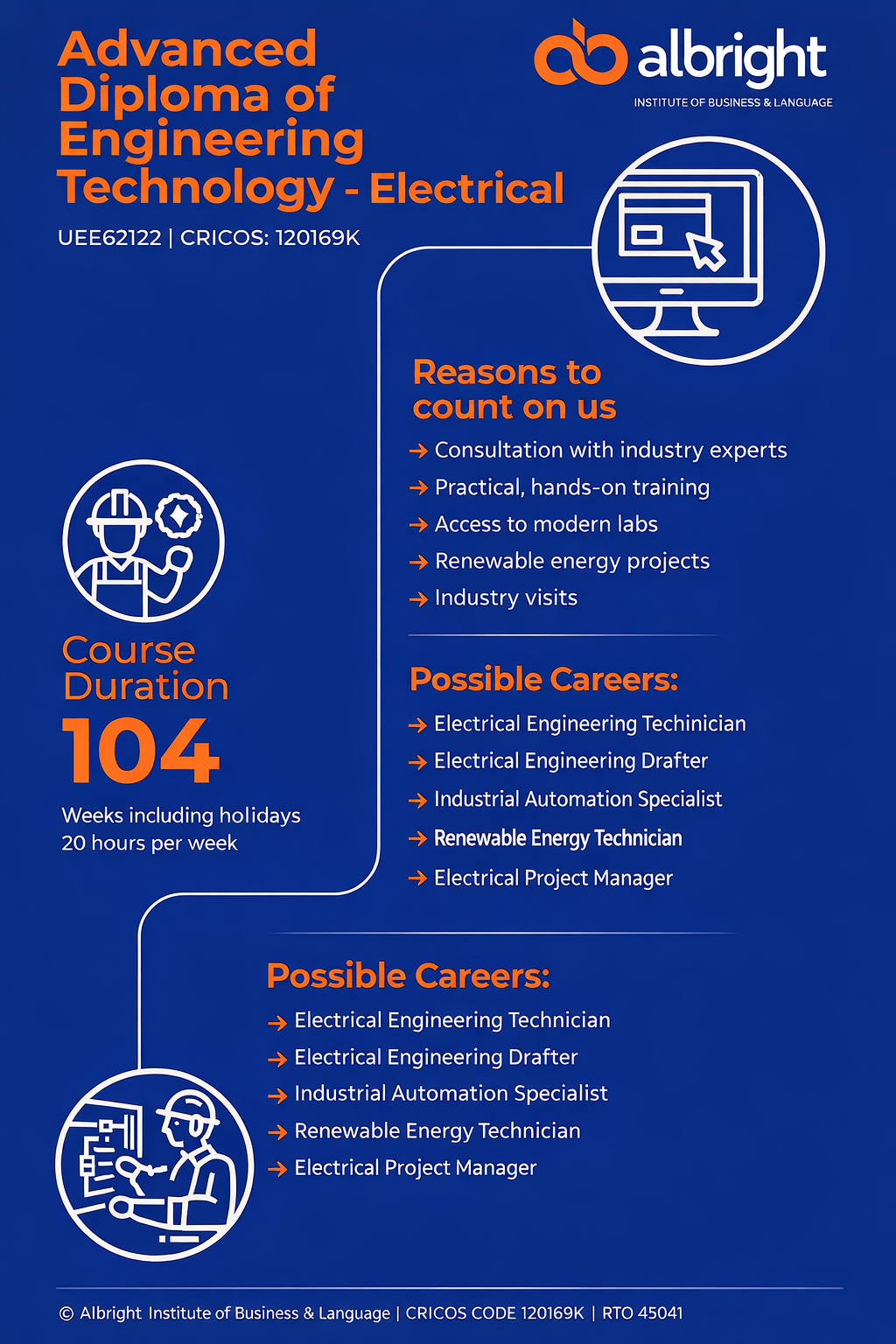
- 104 Weeks Including holidays
- 20 hours per week
| Unit Code and Title | Type | Weighting Points | Pre-requisite unit/s |
|---|---|---|---|
| UEECD0007 Apply work health and safety regulations, codes and practices in the workplace | Core | 20 | |
| UEECD0046 Solve problems in single path circuits * | Core | 40 | UEECD0007 |
| UEECD0044 Solve problems in multiple path circuits* | Core | 40 | UEECD0007, UEECD0046 |
| UEECD0064 Interpret, produce and modify electrotechnology drawings | Core | 40 | |
| UEECD0004 Apply material science to solving electrotechnology engineering problems | Core | 60 | |
| UEECD0039 Provide solutions to basic engineering computational problems* | Core | 60 | UEECD0007 |
| UEEEL0021 Solve problems in magnetic and electromagnetic devices* | Core | 30 | UEECD0007, UEECD0046, UEECD0044 |
| UEEEL0019 Solve problems in direct current (d.c.) machines* | Core | 30 | UEECD0007, UEECD0046, UEECD0044, UEEEL0021 |
| UEECD0005 Apply physics to solving electrotechnology engineering problems | Core | 60 | |
| UEEEL0020 Solve problems in low voltage a.c. circuits* | Core | 80 | UEECD0007, UEECD0046, UEECD0044, UEEEL0021 |
| UEEEL0079 Plan and analyse LV electrical apparatus | Core | 60 | |
| UEECD0036 Provide engineering solutions for problems in complex multiple path circuits | Core | 60 | |
| UEEEL0077 Evaluate and report on the performance of LV machines * | Core | 100 | UEEEL0020, UEEEL0021 |
| UEEEL0080 Plan and analyse wiring systems, circuits, control and protection for electrical installations | Core | 100 | |
| UEERE0013 Develop strategies to address environmental and sustainability issues in the energy sector | Core | 20 | |
| UEECD0026 Manage risk in electrotechnology activities | Core | 60 | |
| UEECD0014 Develop design briefs for electrotechnology projects | Core | 40 | |
| UEECD0010 Compile and produce an energy sector detailed report | Core | 60 | |
| UEEEL0062 Provide engineering solutions to problems in complex polyphase power circuits* | Core | 60 | UEECD0036, UEEEL0020 |
| UEECD0059 Write specifications for electrical engineering projects | Core | 40 | |
| UEEEL0015 Manage large electrical projects* | Core | 40 | UEECD0007 |
| UEEEL0058 Plan large electrical projects* | Core | 60 | UEECD0007 |
| UEECD0003 Apply industry and community standards to engineering activities | Core | 20 | |
| UEECD0056 Apply methods to maintain currency of industry developments | Core | 20 | |
| Total Weighting Points of Core Units | 1200 | ||
| UEEEC0069 Troubleshoot digital sub-systems* | Group A – Imported | 80 | UEECD0000, UEEECO060 |
| UEECD0019 Fabricate, assemble and dismantle utilities industry components* | Group A | 40 | UEECD0007 |
| UEECD0020 Fix and secure electrotechnology equipment* | Group A | 20 | UEECD0007 |
| UEECD0051 Use drawings, diagrams, schedules, standards, codes and specifications* | Group A | 40 | UEECD0007 |
| Total Weighting Points of Group-A Units | 180 | ||
| UEECS0033 Use engineering applications software on personal computers | Group B | 40 | |
| UEEIC0013 Develop, enter and verify discrete control programs for programmable controllers* | Group B | 60 | UEECD0007 |
| UEECD0017 Establish and follow a competency development plan in an electrotechnology engineering discipline | Group B | 120 | |
| UEEEC0060 Repairs basic electronic apparatus faults by replacement of components* | Group B | 40 | UEECD0007, UEECD0019 |
| Total Weighting Points of Group-B Units | 260 | ||
| UEECD0024 Implement and monitor energy sector WHS policies and procedures | Group C | 20 | |
| UEEIC0015 Develop, enter and verify word and analogue control programs for programmable logic controllers* | Group C | 60 | UEECD0007, UEEIC0013 |
| UEEIC0014 Develop, enter and verify programs in supervisory control and data acquisition systems* | Group C | 60 | UEECD0007, UEEIC0013, UEEIC0015 |
| Total Weighting Points of Group-C Units | 140 | ||
| UEEEL0011 Evaluate performance of low voltage electrical apparatus* | Group D | 40 | UEECD0007 |
| Total Weighting Points of Group-D Units | 40 | ||
| UEEEC0014 Design signal-conditioning sub-systems | Group E | 80 | |
| UEEIC0007 Design and use advanced programming tools, PC networks and HMI Interfacing | Group E | 120 | |
| UEECD0049 Use advanced computational processes to provide solutions to energy sector engineering problems* | Group E | 80 | UEECD0007, UEECD0039 |
| UEEEC0005 Assess electronic apparatus compliance | Group E | 60 | |
| Total Weighting Points of Group-E Units | 340 | ||
| Total Weighting Points of All Elective Units | 960 |
Typical Timetable Block*
AM Schedule Block | Start | End |
Period 1 | 9:00 AM | 12:30 PM |
Break | 12:30 PM | 1:00 PM |
Period 2 | 1:00 PM | 4:30 PM |
PM Schedule Block | Start | End |
Period 1 | 2:00 PM | 5:30 PM |
Break | 5:30 PM | 6:00 PM |
Period 2 | 6:00 PM | 9:30 PM |
Compulsory Training Hours:
**Timetables specific to each course or cohort are released before the start of the commencement week and updated at the beginning of each term.
|
This course operates with a student device requirement, as students are required to bring a laptop or similar device and complete regular LMS-based activities.
Melbourne, Sydney, Adelaide & Brisbane

Contact Us
Want more information about our courses?
Submit your contact details here and we will get back to you as soon as possible.